

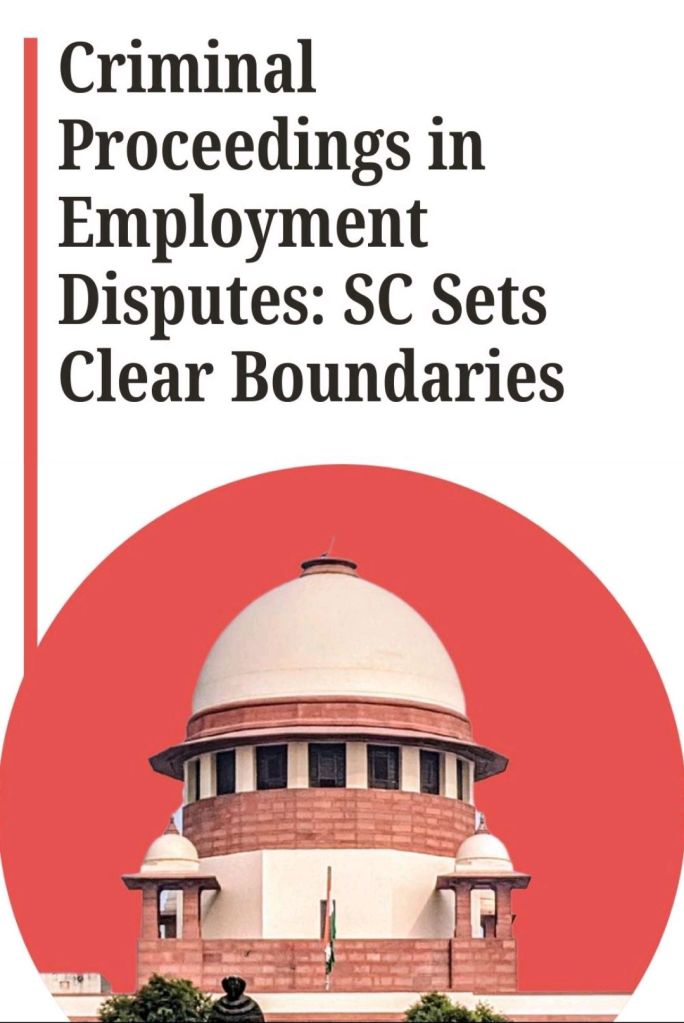
Can an Employment Dispute Be Coloured as a Criminal Offence?
In a recent case, the Supreme Court clarified whether an employment dispute can be framed as a criminal offence. The ruling highlights the fine line between civil and criminal liability in workplace conflicts.
Background
An employee of Juniper Networks India Pvt. Ltd. alleged that she was harassed, coerced into resigning, and wrongfully terminated by her employer. She claimed that the HR Manager:
- Forced her to resign under threat of dismissal,
- Confiscated her personal belongings, and
- Had security forcibly remove her from the premises.
She filed a First Information Report (FIR) against the HR Manager and another senior employee, accusing them of physical and verbal harassment, intimidation, and confiscation of intellectual property.
Legal Proceedings – High Court & Supreme Court
Employer’s Challenge in the Karnataka High Court
The HR Manager and a senior employee filed petitions under Section 482 of the Criminal Procedure Code (Cr.PC), seeking to quash the criminal proceedings against them.
However, the Karnataka High Court refused to interfere, stating that the allegations prima facie constituted criminal offences.
Dissatisfied with this ruling, the employer appealed to the Supreme Court.
Arguments Before the Supreme Court
Employer’s Stand
- The FIR and charge sheet lacked essential ingredients of criminal offences.
- The dispute was civil in nature, but the criminal process was being misused to pressurize them.
Employee’s Stand
- The employer’s actions constituted harassment, intimidation, and coercion.
- The HR Manager confiscated her laptop containing intellectual property.
- She was forcibly evicted from the office.
Supreme Court’s Decision
The Supreme Court quashed the criminal proceedings against the HR Manager and senior employee, ruling that:
- The ingredients of the alleged criminal offences were not prima facie made out.
- There were discrepancies in the complaint, FIR, and charge sheet.
- The dispute was essentially civil in nature and should be dealt with in a labour court.
Key Takeaway
This ruling reaffirms the distinction between civil and criminal disputes in employment matters. While termination and workplace disputes should typically be resolved through labour courts, some employees attempt to frame these issues as criminal cases by adding allegations of harassment or intimidation.
The Supreme Court’s judgment protects employers from unwarranted criminal prosecution while ensuring that genuine labour disputes can be addressed through appropriate legal forums. Employers facing similar legal challenges can seek relief from higher courts to quash unfounded criminal proceedings.
 Dr. Kiran Kakade (Ph.D.,LL.M.,MCA,MBA(HR))