
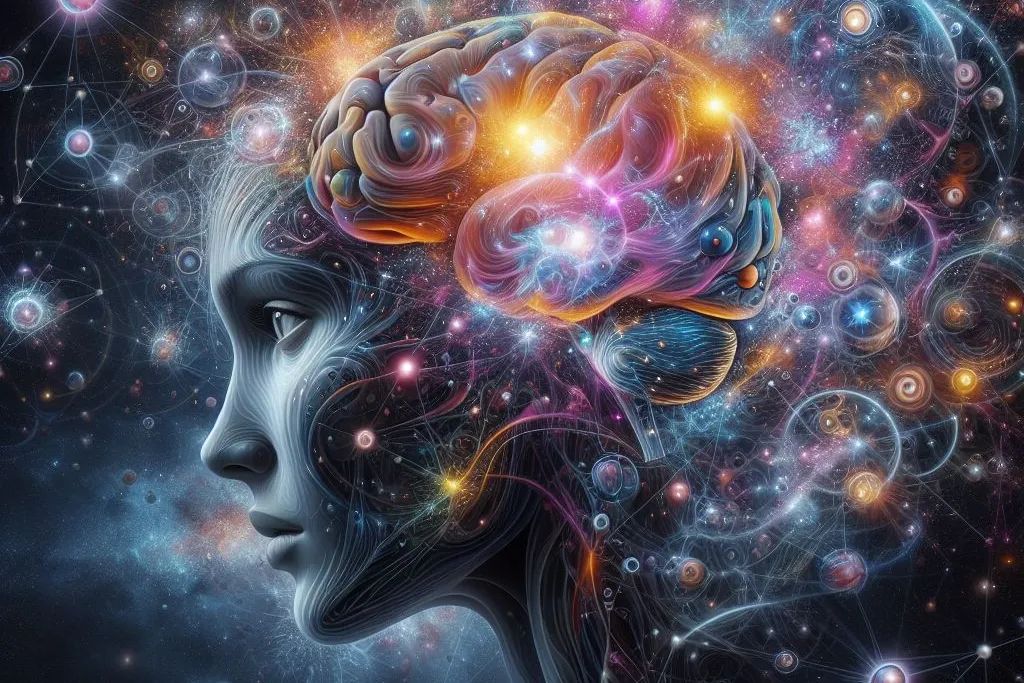
The nature of reality has long been a subject of debate among philosophers, scientists, and spiritual seekers. The Bhagavad Gita, a revered Hindu scripture, and modern simulation theory, as explored by physicist Thomas Campbell, both suggest that the physical world might not be as “real” as it appears. But how do these perspectives compare? Could they be pointing toward the same fundamental truth using different languages—one spiritual and the other scientific?
Let’s explore how the Bhagavad Gita’s philosophy aligns with the idea that reality is an illusion, much like a simulation.
1. The Illusion of Reality: Maya vs. Simulation Theory
In Hindu philosophy, the concept of Maya (illusion) suggests that the material world is not ultimate reality. According to the Bhagavad Gita, our senses perceive a temporary, ever-changing world, but beyond it lies a higher, eternal reality—the spiritual realm.
Similarly, Campbell’s simulation theory proposes that the universe functions like a computer simulation, where reality is not inherently physical but rather a digitally generated experience. His research, based on the double-slit experiment, suggests that matter behaves differently when observed—implying that consciousness plays a role in shaping reality.
Both perspectives challenge the assumption that our physical world is “absolute” reality. Instead, they propose that reality is shaped by a deeper, unseen force—whether divine (as in the Bhagavad Gita) or digital (as in simulation theory).
2. The Role of Consciousness: Atman vs. the Observer
The Bhagavad Gita teaches that consciousness (Atman) is the true self, distinct from the temporary physical body. Krishna explains to Arjuna that the soul is eternal, unchanging, and not affected by the material world.
Simulation theory similarly emphasizes the role of the observer. Campbell suggests that our consciousness interacts with a data-driven universe, determining what we perceive. This aligns with the “participatory universe” concept in quantum physics, where reality only exists when observed.
This raises an important question: If we are living in a simulation, then who (or what) is running it?
3. The Creator: Krishna vs. the Programmer
In the Bhagavad Gita, Krishna declares:
“I am the source of all spiritual and material worlds. Everything emanates from Me.” (BG 10.8)
If the universe is a simulation, there must be a creator—a force or intelligence designing the system. While Campbell’s work doesn’t define who or what that might be, many interpretations of simulation theory suggest that a higher intelligence—whether an advanced civilization or a cosmic consciousness—designed our reality.
Could Krishna be the “programmer” of reality, creating an interactive world for soul evolution?
4. The Purpose of Life: Dharma vs. the Goal of the Simulation
The Bhagavad Gita teaches that life has a purpose (Dharma)—each individual has a duty aligned with their nature. Krishna advises Arjuna to perform his duty without attachment, as true fulfillment comes from realizing the eternal self.
If the universe is a simulation, then what is its purpose? Campbell suggests that reality is a learning platform where consciousness evolves. Some scientists speculate that our world is designed to test or refine intelligence, much like characters in a virtual reality game learning and growing.
This suggests an interesting parallel: If our world is a simulation, then waking up to reality—whether through spiritual enlightenment or scientific discovery—could be the key to understanding our true existence.
Conclusion: Different Paths, Same Truth?
The Bhagavad Gita and simulation theory come from different traditions—one ancient and spiritual, the other modern and scientific. Yet, they both question the nature of reality, the role of consciousness, and the existence of a higher intelligence.
- The Bhagavad Gita teaches that reality is Maya, and true knowledge comes from realizing one’s eternal self.
- Simulation theory suggests that reality is digital, and understanding its nature could reveal what lies beyond.
If we take both ideas seriously, they point to the same fundamental truth: What we see as “reality” is not the ultimate truth. There is something beyond.
So, are we living in a simulation or trapped in Maya? Either way, the key question remains:
How do we wake up?
 Dr. Kiran Kakade (Ph.D.,LL.M.,MCA,MBA(HR))