

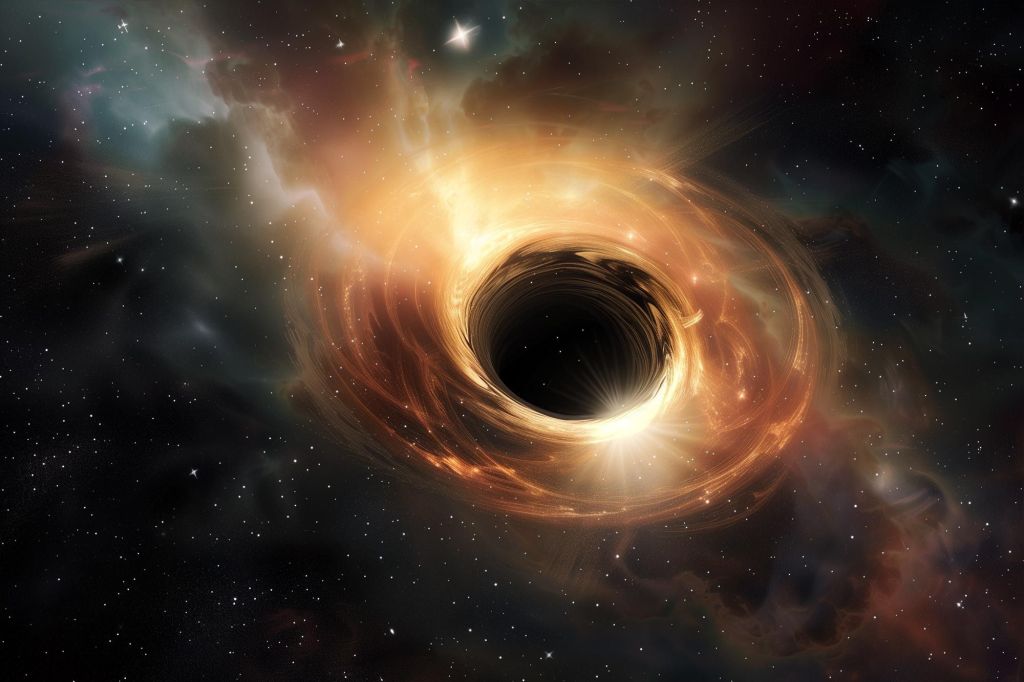
A groundbreaking study using the James Webb Space Telescope (JWST) has revealed a strange cosmic pattern that challenges our fundamental understanding of the universe. Researchers at Kansas State University analyzed 263 distant galaxies and found that a surprising majority rotate in the same direction. This unexpected discovery has sparked a bold and controversial idea: Could our universe be inside a black hole?
The Cosmic Rotation Mystery
Traditionally, galaxies should be randomly oriented, with no clear preference for clockwise or counterclockwise rotation. However, the study found that 60% of the galaxies rotate clockwise, while only 40% rotate counterclockwise relative to the Milky Way. This imbalance suggests that the universe itself might have a preferred direction of rotation, which contradicts the widely accepted view that the universe is isotropic (having no special direction).
This finding has led scientists to revisit an old but fascinating idea: Black Hole Cosmology.
Black Hole Cosmology: A Universe Within a Universe?
The idea that our universe exists inside a black hole isn’t new. Raj Kumar Pathria and I. J. Good first introduced this concept, also known as Schwarzschild cosmology. It proposes that:
- The event horizon of a black hole might actually be the boundary of our observable universe.
- Everything we see could be the interior of a black hole within a larger parent universe.
- Every black hole we observe could be a doorway to another “baby universe”, suggesting a multiverse connected through black holes.
The Implications: A New Perspective on the Cosmos
If this theory holds, it could have far-reaching implications for our understanding of space, time, and even the possibility of parallel universes. It could explain:
- Why our universe appears to have an expansion limit (similar to the event horizon of a black hole).
- The mystery of dark energy—perhaps the “pull” of another universe is influencing ours.
- Whether time behaves differently inside a black hole, which could impact theories on time travel and cosmic evolution.
What’s Next?
This discovery raises more questions than answers. Could the universe’s rotation be a remnant of a larger cosmic structure? Does this suggest a deeper connection between black holes and the fabric of reality? While the idea of living inside a black hole may seem far-fetched, ongoing research with telescopes like JWST could bring us closer to unlocking the secrets of our cosmic origins.
One thing is certain: the universe is far stranger than we ever imagined.

 Dr. Kiran Kakade (Ph.D.,LL.M.,MCA,MBA(HR))