
In a world increasingly defined by boundaries—geographical, cultural, and ideological—we often forget a timeless Indian wisdom:
“Vasudhaiva Kutumbakam” — The world is one family.
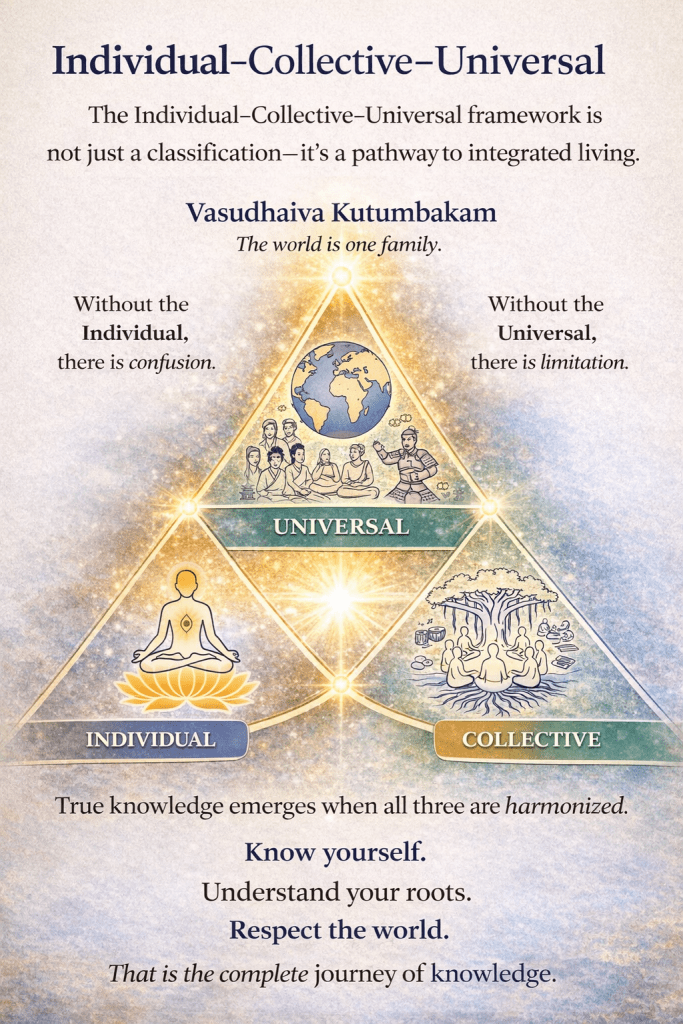
This profound idea is not just a moral statement; it is a knowledge framework for living. The diagram of Individual–Collective–Universal reflects this journey—a movement from self-awareness to global harmony.
It reminds us that knowledge is not fragmented. It is layered, interconnected, and evolutionary.
1. The Individual: The Foundation of Awareness
Every journey begins within.
The Individual layer represents self-awareness—our thoughts, values, emotions, and purpose. It asks:
- Who am I?
- How do I live?
- Why do I act the way I do?
Without this understanding, life becomes reactive and directionless.
Without the Individual, there is confusion.
Self-knowledge creates clarity. It anchors us in authenticity and prepares us to engage meaningfully with others.
2. The Collective: The Space of Belonging
From the self, we move to the Collective—our family, community, culture, and civilization.
This layer represents shared practices, traditions, and values. It answers:
- Who are we?
- What binds us together?
- Why do we live the way we do?
Without the Collective, there is isolation.
Understanding the collective gives us identity and belonging. It connects us to our roots and helps us appreciate the wisdom embedded in traditions.
This is where cultural frameworks like Indian Knowledge Systems (IKS) become vital—they guide us in balancing individuality with social harmony.
3. The Universal: The Expansion of Consciousness
The final layer is the Universal—the world beyond our immediate identity.
It represents openness to diversity, respect for differences, and the ability to see humanity as one interconnected whole.
Without the Universal, there is limitation.
When we fail to engage with the wider world, our thinking becomes narrow. But when we embrace diversity, we evolve.
Vasudhaiva Kutumbakam: The Integrating Principle
At the heart of this framework lies the powerful idea:
“Vasudhaiva Kutumbakam” — The world is one family.
This principle transforms the pyramid into a circle of unity:
- The Individual is not isolated
- The Collective is not exclusive
- The Universal is not distant
Instead, all three are interconnected expressions of one reality.
Harmony: The Essence of True Knowledge
The diagram conveys a powerful truth:
True knowledge emerges when all three are harmonized.
Knowledge is incomplete if:
- It focuses only on the self (leading to ego)
- Only on the group (leading to bias)
- Only on the world (leading to detachment from roots)
Balance is the key.
The Complete Journey of Knowledge
The framework ultimately simplifies into three guiding principles:
- Know yourself.
- Understand your roots.
- Respect the world.
This is not just philosophy—it is a way of living, leading, and learning.
Conclusion
In today’s globalized yet fragmented world, the integration of Individual–Collective–Universal guided by Vasudhaiva Kutumbakam offers a powerful model for education, leadership, and human development.
It reminds us that:
- We begin as individuals
- We grow within communities
- We evolve into global citizens
And in this journey, we realize a deeper truth:
We are not separate—we are connected.
We are not isolated—we belong.
We are not limited—we are part of a universal whole.
That is the complete journey of knowledge.
 Dr. Kiran Kakade (Ph.D.,LL.M.,MCA,MBA(HR))