

In today’s fast-paced and emotionally demanding world, a subtle yet powerful trend is emerging in society. People are increasingly drifting into two psychological orientations — those who remain empathetic and socially connected, and those who, due to life’s harsh experiences, turn self-centric and emotionally withdrawn.
This divide is not merely about attitude; it reflects deeper psychological, social, and even philosophical dimensions of human existence.
The Empathetic Few: Quiet Contributors to Society
There exists a group of individuals who may appear introverted on the surface, yet they possess a deeply positive and compassionate mindset. These individuals:
- Care genuinely for others
- Contribute to society without expectations
- Value relationships and emotional bonds
- Practice empathy as a natural way of living
Interestingly, their introversion does not isolate them. Instead, it strengthens their inner world, making them more reflective and emotionally intelligent. They do not seek validation, yet their presence creates value in families, workplaces, and communities.
Their guiding principle often aligns with the timeless wisdom of selfless action — to give without expecting in return. This mindset fosters not only personal peace but also collective harmony.
The Other Side: When Pain Breeds Negativity
On the other hand, there is a growing segment of individuals shaped by negative experiences — betrayal, neglect, failure, or emotional hurt.
These individuals often adopt a defensive philosophy:
- “I will think only about myself.”
- “No one supported me, so why should I care?”
- “I don’t need anyone.”
While this mindset may initially serve as a psychological shield, over time it transforms into a barrier — isolating them from meaningful human connections.
What is important to understand is that such negativity is not always a choice. It is often a reaction to repeated emotional injuries. Society sometimes fails these individuals, and in response, they disconnect from it.
The Paradox of Self-Centric Living
A striking contradiction appears in such self-centric behavior.
- When they need emotional or psychological support, they seek others.
- But when others need them, they withdraw, claiming independence.
This double standard is not hypocrisy in the traditional sense — it is a sign of unresolved emotional conflict.
Over time, this leads to:
- Loneliness
- Social isolation
- Reduced emotional resilience
- Potential psychological distress
Humans, by nature, are social beings. From an evolutionary perspective, survival has always depended on cooperation, trust, and shared existence. Denying this fundamental truth creates an inner imbalance.
Human Interdependence: A Psychological Reality
No matter how strong or independent one claims to be, the reality is:
We are psychologically and emotionally dependent on others.
- We need conversations to process thoughts
- We need relationships to feel belonging
- We need support systems during crises
Complete emotional isolation is not strength — it is often a silent struggle.
Wisdom from the Bhagavad Gita: The Path of Selfless Action
Ancient Indian philosophy provides profound insight into this dilemma.
The Bhagavad Gita emphasizes:
“Perform your duty selflessly, without expecting rewards.”
This principle is not about ignoring oneself, but about transcending ego-centric thinking. It teaches balance:
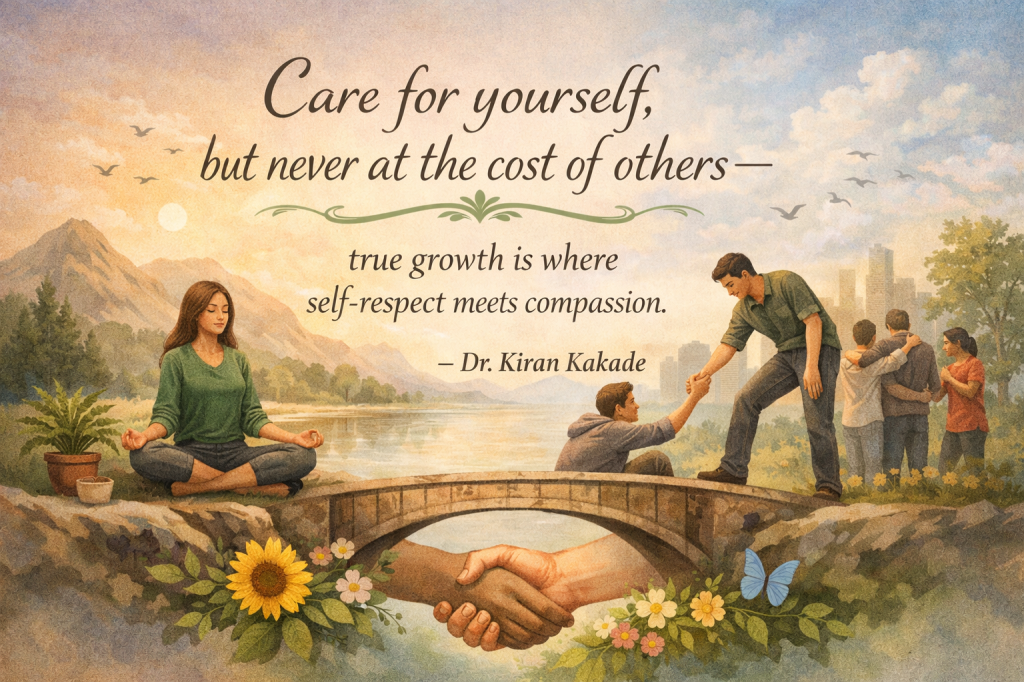
- Care for yourself, but not at the cost of others
- Contribute to society, even in small ways
- Detach from expectations, not from relationships
This approach nurtures both inner peace and social harmony.
Why This Trend Needs Attention
The rise of emotional withdrawal and self-centric thinking is not just an individual issue — it is a societal concern.
If left unaddressed:
- Communities weaken
- Trust diminishes
- Mental health challenges increase
- Social fragmentation intensifies
A society cannot thrive if individuals choose isolation over connection.
The Way Forward: Rebuilding Balance
Addressing this trend requires both individual reflection and collective responsibility.
For Individuals:
- Acknowledge emotional pain, but don’t let it define your identity
- Practice small acts of empathy
- Stay open to connection, even if cautiously
- Seek help when needed — it is not weakness
For Society:
- Create emotionally supportive environments
- Encourage open conversations about mental health
- Reduce judgment and increase understanding
- Recognize that behind negativity often lies unhealed pain
Conclusion: Choosing Connection Over Isolation
Life experiences may push individuals toward negativity, but staying there is a choice that comes at a cost.
True strength lies not in saying “I don’t need anyone”, but in understanding:
“I am part of a larger human network — and my well-being is connected to others.”
Empathy, selflessness, and balanced interdependence are not just moral values — they are psychological necessities for a healthy life.
In the end, the question is simple:
Will we build walls around ourselves, or bridges toward others?







 Dr. Kiran Kakade (Ph.D.,LL.M.,MCA,MBA(HR))