10 skills effective leaders must possess in digital age

The hyper-connected, dynamic work environment requires organisations to redefine the traits of an effective leader in the digital era.

The new-age digital world of work is different from how it was until a few years back, and in line with that, the definition of effective leadership has also undergone a sea change. In addition to inspiring and supporting people to achieve the desired outcomes, the digital era requires leaders to be more agile and nimble in adopting the new times, and yet be very grounded in ensuring the same human connect that brings people together to work efficiently.

This is why, developing great leaders is now one of the biggest agendas for chief executives across organisations. This hyper-connected, dynamic work environment now requires organisations to re-look at their long-held leadership-grooming models, and the foremost step in that direction is to redefine the traits of an effective leader in the digital era. Here are some key skills that leaders need to possess in the age of digital transformation.

Agility

This is one trait that has been really overhyped in how it has been used ins various contexts across business, while losing out its real essence and application in the real world. Agility in mindset, behaviour and actions is a key skill for leaders in the digital age. The ability to use iterative approaches to divide work efforts into short phases, for early and frequent evaluation; and the flexibility to pivot and transition between varied roles and activities is what makes one agile in the true sense.

Cross-functional dexterity
This is an important quality for leaders, to be able to effectively collaborate across a range of functions, ensuring interconnectedness and streamlined operations across the organisation. In addition, great leaders are capable of offering solutions to cross-functional challenges.

Is your business ready to adapt? Do your leaders have the required skills to take your business forward?

Design thinking
It is the ability to take a design-centric approach to work, while combining empathy, ingenuity and rationality, to address customer needs. This can be achieved by observing behaviour and drawing conclusions about what customers want and need.

Analytical/data-driven mindset
This is one of the most crucial and defining skills that leaders need to possess to be able to survive and be effective in the digital age. Using data and insights for better decision-making and the ability to take a balanced approach to make data-driven decisions have become vital to working in times of big data and analytics.

Virtual collaboration
With flexi-working and remote-working becoming increasingly common, the leadership rules for managing remote or virtual teams have also changed. New-age leaders need to be able to productively drive engagement and demonstrate the power of their presence, even as leaders of virtual teams. They need to be open to leveraging behaviours, practices, techniques and tools that facilitate ef?cient and effective cooperation among dispersed collaborators.

New media literacy
Being socially active and leveraging all media to effectively communicate is essential for leaders in the ‘here and now’ times. This skill entails the ability to leverage new media for persuasive communication and use techniques that target social networks and applications to spread brand awareness and promote products and services.

Computational thinking
This is a problem-solving technique that allows one to decompose a certain problem into smaller, more manageable fragments that are easy to analyse and then draw patterns to look for feasible solutions. It is the ability to understand and practise data-based reasoning, and translate data into abstract concepts. It is what makes leaders adept at finding effective solutions to complex issues in the digital era.

Passion for continuous learning
One trait that never fades out, but has become even more important in the fast-paced dynamic work environment now, is the zeal to learn more. The enthusiasm to seek out and acquire new information and knowledge coupled with a sense of curiosity and a willingness to continue to develop and grow is what will prevent leaders from getting outdated in times of digital transformation.

Team-based orientation
One of the evergreen and most essential skills that leaders need to display is the ability to understand and use behaviours, practices and processes that optimise team interaction and facilitate achievement of common goals. Being an accountable leader to the team and having a desire to achieve consensus and involve others in decision making is vital for any leader to succeed meaningfully in the present times, and more so in those to come.

Customer-centric orientation
A skill that is important for every employee in an organisation, but is a make or break for determining the efficiency of a leader is customer orientation. Great leaders consider customer experience above all. The skill involves using practices and techniques to identify and resolve pain points most critical to the customer.

Leaders in the digital transformation age cannot do without the new skills mentioned above. In addition to conventional skills that never run out of importance, these skills here will redefine effective leadership in the times to come. They will determine how good leaders function and organisations need to consciously identify and develop their leaders with a strong focus on these skills.

Source :HRKatha.com

Top skills required for digital transformation

Those leading digital transformation need other soft skills in addition to technological expertise.

Every organisation wants to jump onto the digitisation bandwagon. It’s the latest buzzword. Not surprising, since that’s affecting business like nothing else has ever done. According to a Bersin By Deloitte study, 90 per cent of organisations surveyed believe their core business is threatened by new digital competitors.

Digitisation doesn’t only affect the way we deal or interact with our customers but it also impacts the way organisations are structured, the way we work and what new skills are required—both now and in the immediate future.

Digitisation erases the legacy mindsets, and paves the way for more agile, collaborative, innovative and adaptive methods of doing business.

Unfortunately, 70 per cent of the companies surveyed by Bersin By Deloitte, agree that they do not have the right leadership, skills, or operating models to adapt.

One must remember that digital transformation is not just about implementing fancy new tools. A company successfully transforms itself into a digital company when people obtain digital skills. Of course that has to start with the leader of the organisation and should spread top to bottom.

Digital transformation is often owned by the chief technology/information officer with strong inputs from the chief executive officer.

It’s also important for companies to evaluate and understand what ‘digital talent’ means. Until the company fully understands the digital profiles, or job functions, available in the market and within the company, there can be no clear way to determine how many digital employees—and in what profiles—it must recruit, develop and retain.

However, the team needs to have the following skills for successful digital transformation.

1. Data analytics

Any digital transformation project will incur a high volume of data. Therefore, data analytics, market research analytics and database administration skills should be the most sought after skill sets.

Suppose a bank wants to implement a Robotic Process Automation (RPA) solution that uses intelligent software or robots to automate the repetitive and mundane data collection and entry tasks between the websites, banking systems, internal applications and other portals. The skills it should seek are those pertaining to data analytics, which is indispensible.

2. Digital literacy
Digital literacy is the ability to use information and communication technologies to find, evaluate, create and communicate information, requiring both cognitive and technical skills. So it’s much more than just technical knowledge.

It’s not necessary for the digital team to be digital native, but the team members need to understand and appreciate the role technology plays in their daily and professional lives.

3. Learnability

People with a creative bent of mind, and those with cognitive flexibility and emotional intelligence are important, but the most important aspect is learnability. Businesses need to recruit people who are willing to learn, upskill and keep pace with the changing skill sets digital transformation continues to introduce. In addition, they should not be afraid to take risks, fail, and innovate and it’s not just in technology but also in new management and leadership techniques.

4. Change-management skills

Yes, it’s a digital world, but the human touch and interaction is necessary. Digitisation could disrupt the lives of many employees, which is why people with effective communication and analytics skills and those who can manage change will be required. It is important to keep the team spirit alive with regular and personalised communication and face-to-face meetings as well.

5. Ability to facilitate, plan and inspire

The digitisation team is the mediator between digital immigrants and digital natives. Both are important for the business and the job of the digitisation team is to bridge the gap between the two so that everyone in the organisation benefits from the transformation.

The team should comprise visionaries, who also possess the ability to inspire others to believe in their plans.

6. Ability to motivate
Successful leaders possess a vision, and the ability to convince others too to believe in their vision. This means that digital leaders need to be great storytellers to be able to connect and motivate others. While there will be early adopters, there will also be doubters who will need time to acclimatise themselves to the new technology. The leaders will have to handle both.

Digital leaders need not only be technological experts but also be able to envision possibilities that don’t yet exist.

The digital team or the organisation undergoing digital transformation needs to keep one simple thing in mind–people come first.

Forcing people to use a new tool or to adopt new processes at a moment’s notice will only lead to them rejecting the new measures. It’s important to communicate the benefits of the new technology and processes to the team and offer sufficient training and coaching to familiarise people with it. Digital transformation shouldn’t be a chore, it should become part of the organisation and everyone should live it.

Source : HRKatha.com

On-cloud vs on-premise digital HR solutions: Where to place the bet?

Despite acknowledging and appreciating the various benefits that on-cloud HR solutions offer in contrast to on-premise ones, some organisations are unable to switch to or adopt on-cloud solutions. Here’s how to approach the concerns.

Hosting digital solutions on the cloud is not new anymore. However, the debate on whether it is better in comparison to the old-school on-premise solutions, is still hot. It’s one of the critical criteria to decide on when looking to digitise HRMS, but also one that determines the effectiveness and the outcome of the entire effort.

Now, although cloud-based HR solutions are gaining importance rapidly –especially among small to mid-sized businesses – there are some industries and organisations that still hesitate to accept the cloud as a better solution than on-premise systems, for instance, the BFSI sector.

A majority of organisations in the sector, despite acknowledging and appreciating the various benefits that on-cloud HR solutions offer in contrast to on-premise ones, are not able to switch to or adopt on-cloud solutions.

Source : HRKatha. com

The ‘Hawthorne Effect’ in the modern workplace

2e53de5e273acde08ffef17a3898f3bd-696x382.jpg

Employees, irrespective of the era they belong to, always desire to be heard and valued; this is what motivates them and ultimately enhances productivity.

In 1924, an experiment was conducted by Elton Mayo, an Australia-born sociologist at the Hawthorne plant of the Western Electric Company, which made telephone hardware for AT&T.The simple experiment was aimed at evaluating the effect of working conditions on productivity. When the lighting in the work area for few workers was increased, it was observed that the productivity of the workers in that particular bay had also increased. This went on to establish the fact that change improved productivity.These workers were also part of several other successful experiments in the following years. Their working hours and rest breaks were altered, and they were offered food during breaks. It was observed that every small change brought in an improvement in productivity.The experiments continued till 1932 and all these changes were reversed assuming that the productivity will fall, but surprisingly there was no fall in productivity levels.

Mayo established that it wasn’t the change in physical environment that increased productivity, but the belief of workers that they were valued, taken care of and that someone was concerned about their workplace. In addition, getting the opportunity to discuss changes before they were implemented contributed to the rise in productivity. This theory has been termed the Hawthorne effect.This laid the foundation for what we call employee engagement today. It’s a known fact that engaged employees are the most productive ones.However, Mayo’s experiment has been evaluated differently by different researchers. Many people with a conflicting point of view say that the increase in productivity level was because of the fact that the employees knew they were being observed and that they had to perform better.

Yes, it is a fact that whenever a group of employees are separated from the team and given extra attention and priority, they are likely to perform better. But does that mean that organisations can follow it as a regular practice? Will that not amount to discrimination against others?However, despite all criticism, what the Hawthorne effect establishes is that employees, be it in the 1920s or a hundred years later, want to be heard and valued. That is what increases their motivation level, and the final outcome is enhanced productivity.

Here are a few ways in which the ‘Hawthorne Effect can be used in modern workplaces.

1. Listening is important

The Hawthorne effect established that the productivity of employees increased dramatically when they felt they were being heard. In fact, this is a great lesson for today’s leadership, who need to give a patient hearing to their team members.

It’s important to appreciate ideas and many start-up organisations have benefitted from this where younger employees were heard and their ideas appreciated. People are mainly motivated not by economic factors, but emotional factors, such as a feeling of being involved and receiving attention. It is important for employees to feel that their concerns are being heard and that they are contributing to a common purpose.

2. Observation over vigilance

The Hawthorne effect established that employees tend to perform better when they are being observed. But it has different connotations in the modern workplace. Employees hate being under vigilance 24×7, but yes, they want to be observed. They want the leaders to take notice of their good work, and be appreciated for the same, without being watched all the time. Paying attention to what employees are doing brings in some wonderful results.

3. Right people in the right group

Employees who are usually productive can become unproductive when placed in the wrong group. At the same time, attentive and communicated mindfulness of how others are working may have a positive impact on their engagement and increase productivity. During the Hawthorne experiment, two insubordinate and mediocre workers were replaced by two productive workers, of which one took on the role of straw boss. They discovered that production increased by the replacement of the two workers, due to their greater productivity and the effect of the disciplinary action on the other workers.

4. Gender diversity

Women are increasingly entering male-dominated professions. However, they are often made to feel unwanted by male peers, which leads to low productivity. Employers need to be observant and bring in small changes to make the environment more conducive. The individual attention and the normal human instinct to feel ‘chosen’ will skew the results.

5. God of small things

Organisations need to realise that the tools used for motivation don’t need to be in the form of ‘big’ things. Sometimes, small changes work wonders in improving productivity.

Source : https://www.hrkatha.com

How to make the workplace digitally efficient and secure

cyber-security-3216076_640

With technological advancement and automation, workplace experiences are getting better and increasingly tech-savvy. Even while artificial intelligence (AI) is perceived by many as a threat to job security, a surprisingly large number of people are ready to adapt it; and many are open to a completely automated workplace. However, with so many people accessing and using company data in a technology-driven organisation, there is always a risk of hacking and misuse.

A digital workplace has a bouquet of advantages. A study by Aruba, on behalf of Hewlett Packard Enterprise, reveals that employees in digital workplaces are not only known to be productive and highly motivated, but are extremely satisfied with their jobs and experience better mental and physical health.

Digital revolutionaries vs digital laggards

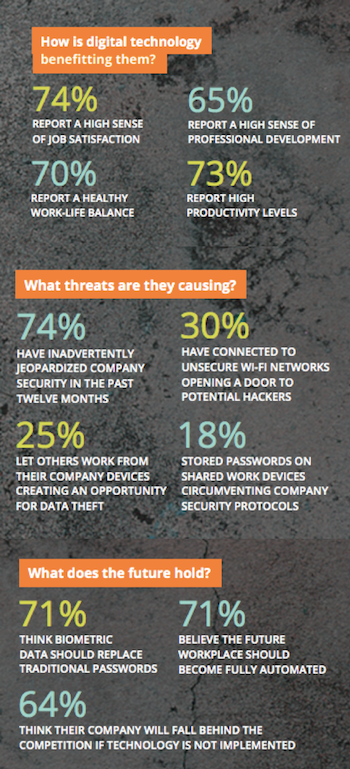
As per the study, employees who worked on the latest technologies at work were 51 per cent more likely to enjoy better job satisfaction and experience 43 per cent more positive work-life balance than their counterparts who work in less tech-driven environments. The former are referred to as ‘digital revolutionaries’ who are also likely to be 56 per cent more motivated to perform at work, than the latter, called ‘digital laggards’. The digital revolutionaries are 83 per cent more likely to appreciate their company’s vision.

More digital revolutionaries (65 per cent) experienced professional development and growth through the use of digital technology, as compared to 31 per cent of the laggards. Also, 72 per cent of revolutionaries were found to be more capable of adopting new skills at work compared to 58 per cent of laggards.

73 per cent of digital revolutionaries claimed that digital technology had increased their productivity, with 70 per cent claiming it had improved collaboration. Only 55 per cent laggards shared this belief.

While there is a segment that believes automation will take away their jobs and render humans redundant at work, the study reveals that 71 per cent of the respondents are keen to work in a fully automated workplace. The digital revolutionaries, especially, are willing to be part of a smarter and more efficient workplace. 98 per cent of respondents across the Asia Pacific believed that more use of technology can improve their workplaces. 70 per cent believed their company will be defeated by competitors if they fail to adopt new technology. 67 per cent were of the opinion that the traditional office will become redundant with technological advancement.

Sixty-three per cent of the respondents were sure that digital technology will make their workplace more efficient, while 53 per cent believed it will make it more collaborative and 52 per cent admitted it will add more appeal to the workplace.

Vulnerability of official data and devices

Sudies have shown that digitally-savvy organisations stay ahead of competition and also attract the best talent from the marketplace. Employees working in such organisations enjoy better work-life balance than their counterparts in other organisations that are less technology-driven.

Such huge volumes of data being accessed and used by the staff, poses a threat to its security. Devices and passwords are invariably shared amongst staff members, which makes the company data vulnerable.

While more employees (56 per cent) are aware of cyber security, they also admit that they have been putting company data and devices at risk. Seventy-three per cent have admitted to sharing passwords and devices.Twenty-five per cent of the employees have, on occasions, connected to potentially unsafe open Wi-Fi in the past year. Some (20 per cent) use the same password for many applications and accounts, while 17 per cent have been noting down passwords lest they forget them. All these are ways of putting official data and devices at risk.

Dealing with threats and ensuring security

The focus of companies should be to build a strong security system into the design of the digital workplace. The system should be such that it factors in human errors and mala fide intentions. Ideally, the system should be able to adapt to change and be capable of dealing with the unexpected.Simply put, in the race to become digital and tech-savvy, organisations should not ignore cyber resilience. After all, the truth is that it is not easy to keep a cyber breach at bay. Therefore, it makes more sense to invest in a security system that is robust enough to respond effectively and recover without delay.With newer technologies making an appearance almost every other day, we have to realise that hackers are also evolving. Therefore, measures taken to ensure data security in digital workplaces need to evolve too. This is where the collaboration between HR and information security departments becomes important. Cyber-security awareness training is just a small step in the right direction.

The security policy of businesses should be shared with the entire workforce, even with all the external entities that have access to corporate data. With everyone using mobile devices these days, anyone can pose a threat!

Readying the digital workplace for the future

It is essential for IT departments to work in alignment with all stakeholders — business managers, end-users and so on — to chart out a roadmap for the evolution of their digital workplace. To achieve this, new tools, such as smart sensors and customised mobile apps, will have to be installed to make workplace experiences more personalised.

Organisations will need to build collaborative digital workspaces without borders, so that even the remotest workers, partners and customers can be catered to efficiently.

Security measures have to be built into the digital workplace at the time of designing itself. This design should factor in the possibility of human error as well as those with mala fide intentions.

The smarter workplaces of today are giving rise to smarter employees. The modern workplace is witnessing an improvement in the hiring process and also a higher rate of offer acceptances. This is definitely a good sign and indicates advantages beyond mere improved productivity. Once the security threats are taken care of, going digital will mean only interesting times ahead for the workforce.It is time for HR to work in tandem with the business, to look at this digital revolution as an opportunity to help people engage with work in novel ways. They have to combine technology with cognitive sciences as pointed out by Joseph White, director of workplace strategy, design and management, Herman Miller. The idea is to focus on attracting the best talent, retaining them and ensuring quality experiences at the individual level.

Source: https://www.hrkatha.com

Miss u Kalam sir…….

In 2014, we visited Mumbai to attend the fiftieth anniversary celebrations of a local college. It was a modest celebration, and A P J Abdul Kalam was happy to see that the college was catering to students from low-income families, giving them quality education at affordable fees. Kalam was greeted with a lot of cheering when he entered the hall. Through his speech he addressed the concerns of the youth who had come from challenging economic conditions. He spoke about his own life, his failures and his successes.
He spoke of the great Nobel Laureate Mario Capecchi, a victim of the Second World War, who had lost most of his family in the war. He had to spend his childhood in an orphanage. But despite his difficulties, he persevered and went on to … become a renowned scientist. At the end of his speech, Kalam was given a standing ovation. This was followed by a question-and-answer session. He answered each question with his usual wit and grace. Suddenly, a young student of about twenty stood up to ask a question: “Sir, you have had so many successes.
I am sure you had some failures too. You always say that you have built your successes over the lessons learnt from failures. I want to know something. Is there something that you could not do, and still regret not doing it?”A P J Abdul Kalam took his time to think through the answer and finally replied, “You know, back home, I have an elder brother who is ninety-eight years old now. He can walk slowly, but steadily, and completely on his own. He has a little problem with his vision and hence there is always a need to keep the house well lit, especially in the night.
“Now you see, in Rameswaram, there are power cuts sometimes. Thus it becomes difficult for him to move about freely. So, last year I got a rooftop solar panel installed at home, with a good battery. When the sun shines, the panel gives power, and in the night the battery takes over the power supply. Now there is plenty of power all the time. My brother is happy. ‘When I see him happy, I also feel happy. But I am also reminded of my own parents. Both of them lived for almost a hundred years and towards their later years they had difficulty seeing things well.
Three decades ago, the power cuts were more frequent. Back then I could do nothing for them. There was no solar power. The fact that I could not do anything to remove their pain is my greatest regret, something which will remain with me forever. ’The answer touched a chord in the hearts of everyone in the audience. Here was a person, more than eighty years old, who had achieved so much in life, but still had the compassion and the humility to speak publicly about his greatest failure.
He was still bothered about failing his parents. How many of us think of such things?I couldn’t help but wonder when I had last stopped to consider my parents’ situation, when I had tried to do anything to ease their burden. Courtesy: Penguin Books, ‘What Can I Give?’ — Life Lessons from My Teacher, A P J Abdul Kalam….. .

Source: Speaking Tree Article

Why do we see fewer women in leadership roles than men?

Though it is a matter of pride that this century has seen women excelling as leaders and not just mothers, wives, care givers and professionals, we are not surprised to see more men than women in leadership positions. While there may be many all-women organisations and a sizeable population of women across hierarchies in various companies, the top positions on the corporate ladder are still dominated by men. Why is that so?

Women do not lack the qualities that are necessary in leaders. In fact, they seem to be blessed with all the traits that are essential in leadership positions. What makes leaders? A desire to excel, grit, determination, long-term vision, ability to convince and influence others, passion for work, an understanding of themselves, compassion for others, ability to adapt, and willingness to learn among other things. Women possess all these and much more. Yet, there are fewer women leaders in this world than their male counterparts.

A study by researchers of New York University, that was published in Frontiers in Psychology, attempts to identify the features that are responsible for the existence of more men in senior leadership roles. It reveals that the communal traits that leaders are expected to possess, such as tolerance and cooperation, are definitely desirable but actually redundant or unnecessary. If an individual possesses them, they act as a bonus. Surprisingly, even women agree that there are more men in senior positions of leadership because they are assertive and competitive. This means, they are up there because of their masculine traits.

Traditionally, women are expected to be demure, caring and nurturing. These characteristics are termed as communal. Men, on the other hand, are seen as dominating, self-confident, and aggressive. In other words, these are the acceptable agentic traits that men are expected to possess.

According to the social role theory, human beings are brought up to believe that women are meant to take care whereas men are meant to take charge. This is so ingrained in the society that if women try to deviate from the norm, or break the mould, they are criticised or even looked down upon for violating the social roles that are actually prescribed for them.

But if they try to fulfill their roles as traditionally prescribed and also try to be leaders, they end up being less effective in their leadership position. In other words, if they attempt to be good leaders and good nurturers, they end up compromising their performance in any one of the two roles. Therefore, irrespective of their leadership style, they will have to deal with some resistance or opposition.

Simply put, women pay the price for all the assumptions culturally imposed on society. They lose out due to the traditional organisational structures, practices, and systems of interaction, that work to the advantage of men.

The most disturbing fact is that, people do not even realise that they are biased when it comes to women occupying senior corporate positions or leadership roles. Unconsciously, women and men have been evaluated differently for senior leadership posts, and continue to be so. And over a period of time when the top ranks come to be dominated by men, the overall perception is that women are not the right choice for those roles. With time, that becomes the norm and accepted practice.

That is why we see lesser women atop the hierarchy than men.

However, the study also reveals that women prefer leaders with more communal traits. But it remains to be seen whether the world will see more leaders with these traits in times to come. However, if that is the trend waiting to catch on, women will surely favour it.

– By Liji Narayan October 16 2018

India’s data protection bill is poorly worded: Stakeholders

India’s data protection bill is poorly worded: Stakeholders
https://economictimes.indiatimes.com/tech/internet/indias-data-protection-bill-is-poorly-worded-does-not-serve-any-stakeholders-interests/articleshow/66066745.cms

Companies step up demand for people with niche skills

Companies step up demand for people with niche skills
https://economictimes.indiatimes.com/jobs/companies-step-up-demand-for-people-with-niche-skills/articleshow/66034533.cms

Why IT firms could soon be forced to let the senior techie go

Why IT firms could soon be forced to let the senior techie go
https://economictimes.indiatimes.com/jobs/why-it-firms-could-soon-be-forced-to-let-the-senior-techie-go/articleshow/66147184.cms