
The Crucial Role of Consumer Awareness: A Reflection on World Consumer Rights Day by Dr. Kiran kakade

World Consumer Rights Day serves as a poignant reminder of the ongoing journey towards ensuring consumer protection and empowerment. With the enactment of the Consumer Protection Act of 2019, India took a significant step forward in this journey, bringing about substantial improvements over its 1986 predecessor. This article delves into the importance of consumer awareness in leveraging the benefits of the 2019 Act and the overall impact on consumer rights and protections.

The Evolution of Consumer Protection: From 1986 to 2019

The Consumer Protection Act of 2019 represents a paradigm shift in the landscape of consumer rights in India. By addressing the complexities of modern commerce and digital transactions, the Act has introduced a more comprehensive and responsive framework for consumer protection. Noteworthy advancements include the expansion of unfair trade practices, the introduction of product liability and unfair contracts, new provisions for e-commerce, and the establishment of the Central Consumer Protection Authority. These changes not only reflect a more nuanced understanding of the consumer-market relationship but also underscore the necessity of informed consumer participation.

Consumer Awareness: The Bedrock of Empowerment

At the heart of the Consumer Protection Act’s efficacy is the concept of consumer awareness. Awareness is pivotal in ensuring that consumers can navigate the market with confidence, making informed decisions and effectively asserting their rights. The ‘Jago Grahak Jago’ campaign is a testament to the government’s commitment to consumer education, highlighting the essential nature of awareness in preventing exploitation and promoting fairness.

The Six Basic Consumer Rights

As enshrined in the Consumer Protection Act, the six basic consumer rights are foundational to understanding the scope of consumer protection. These rights cover the spectrum from the right to safety, to be informed, to choose, to be heard, to redress, and to consumer education. Each right is a critical component in the architecture of consumer protection, offering a guideline for both consumers and providers on the standards of fairness and quality that must be upheld.

The Impact of the Consumer Protection Act 2019

The introduction of the Consumer Protection Act 2019 has been transformative, setting a new standard for accountability and transparency in the consumer market. Through provisions like eDaakhil, for online complaint registration, and the establishment of mediation cells, the Act facilitates a more accessible and efficient redressal process. Moreover, the emphasis on consumer education and awareness ensures that consumers are not passive participants but active, informed stakeholders in their transactions.

The Necessity of Consumer Awareness

Consumer awareness is not just about knowing one’s rights; it’s about understanding the mechanisms of protection available and the means of asserting these rights. The Consumer Protection Act of 2019 offers a robust framework for consumer protection, but its potential can only be fully realized through widespread consumer awareness. Education and information are key to empowering consumers to make choices that are safe, informed, and aligned with their best interests.

Conclusion

As we observe World Consumer Rights Day, let us recognize the strides made in consumer protection with the Consumer Protection Act of 2019 and reaffirm the critical role of consumer awareness. It is through informed, vigilant, and active participation that consumers can safeguard their interests and contribute to a fair, transparent, and equitable market. The journey towards consumer empowerment continues, with awareness at its core, guiding the way towards a more just and consumer-friendly marketplace.


10 Best Startup Idea by Dr. Kiran Kakade

Creating a startup involves identifying a problem or need in the market and developing a solution that is innovative, scalable, and potentially profitable. Here are ten startup ideas across various industries, each with a brief business plan outline:

1. Eco-Friendly Packaging Solutions

  • Problem: Increasing pollution and waste from packaging materials.
  • Solution: Develop biodegradable, compostable, and sustainable packaging options for businesses.
  • Business Model: B2B sales to companies looking to improve their environmental footprint. Revenue through direct sales, subscriptions, or as a packaging consultant.

2. Telehealth Services for Mental Health

  • Problem: Access to mental health services is limited in many areas.
  • Solution: An online platform offering virtual therapy and counseling sessions from licensed professionals.
  • Business Model: Subscription-based for users, with options for pay-per-session. Partnerships with insurance companies and employers could also be explored.

3. AI-Powered Personal Finance Assistant

  • Problem: Managing personal finances can be complex and overwhelming.
  • Solution: An AI-driven app that helps users manage their budget, investments, and savings, offering personalized advice.
  • Business Model: Freemium model with premium features for advanced financial insights and personalized investment advice.

4. Renewable Energy Solutions

  • Problem: The growing need for clean and sustainable energy sources.
  • Solution: Develop and install solar panels, wind turbines, or other renewable energy solutions for homes and businesses.
  • Business Model: Sales of equipment and installation services, maintenance contracts, and possibly energy buyback programs.

5. Mobile Health Clinics

  • Problem: Lack of healthcare access in remote or underserved areas.
  • Solution: Mobile units equipped to offer medical services such as diagnostics, vaccinations, and basic treatments.
  • Business Model: Service fees for patients or subscription models for communities; partnerships with local governments or NGOs.

6. Sustainable Urban Farming

  • Problem: The environmental impact of traditional farming and the demand for local produce.
  • Solution: Vertical farms or hydroponic systems in urban areas to grow produce more sustainably.
  • Business Model: Sale of produce to local restaurants, markets, and direct to consumers through subscription boxes.

7. Educational Tech Tools for Remote Learning

  • Problem: The need for more interactive and effective online learning solutions.
  • Solution: Development of educational software or platforms that provide interactive learning experiences, using AI for personalized learning paths.
  • Business Model: Licensing to educational institutions, subscription for individual users, or freemium models.

8. Zero Waste Stores

  • Problem: Excessive waste from packaging and single-use products.
  • Solution: Retail stores selling products without packaging, encouraging customers to bring their containers, and offering bulk purchasing.
  • Business Model: Retail sales, with potential for online ordering and local delivery services.

9. Wearable Health Tech

  • Problem: The need for continuous health monitoring outside of medical facilities.
  • Solution: Develop wearable devices that monitor vital signs, detect health issues early, and provide data to healthcare providers.
  • Business Model: Sales of devices, subscription services for ongoing monitoring, and data analysis services for healthcare providers.

10. Blockchain for Supply Chain Transparency

  • Problem: Lack of transparency and inefficiencies in global supply chains.
  • Solution: Use blockchain technology to create transparent, immutable records of product origins, handling, and transactions.
  • Business Model: Subscription-based for businesses to access the platform, integration services, and ongoing support.

For each of these ideas, a detailed business plan should include market research, competitive analysis, marketing strategy, operational plan, financial projections, and potential challenges. Tailoring the plan to specific target markets and customer needs will be crucial for success.

๐Ÿ“ข Announcement: Case Study Publication

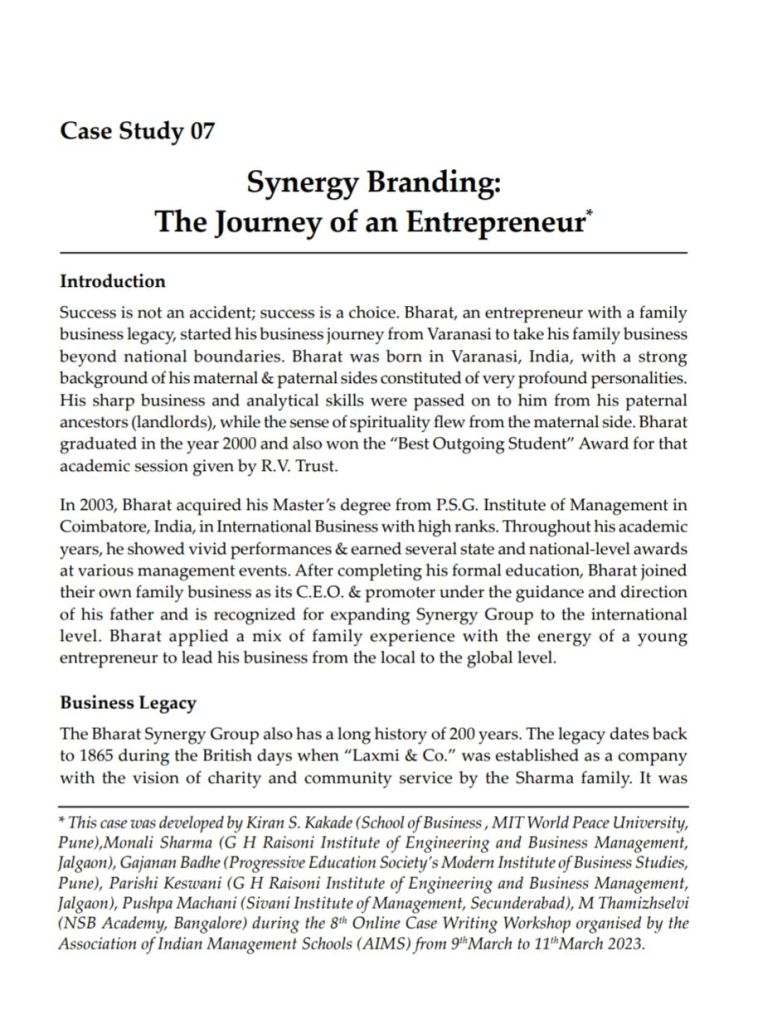
We are delighted to announce the publication of an enriching case study titled “Synergy Branding: The Journey of an Entrepreneur” in the esteemed UGC-CARE Journals, listed under Group I with Journal ID – 101024195.

๐Ÿ“˜ Title: Synergy Branding: The Journey of an Entrepreneur
๐Ÿ“† Volume: 9, No. 2, January 2024
๐Ÿ” ISSN: 2395-6852

This case study is designed to enhance the learning experience for management students and professionals, delving into the inspiring journey of Bharat, a passionate young entrepreneur. By seamlessly blending family experience with youthful energy, Bharat navigated his business from a local scale to a global triumph.

Explore the case for valuable insights on collaborating with existing organizations, selecting optimal products, and forming strategic associations and partnerships in alignment with industry trends. Gain profound insights into the results achieved by the entrepreneur through the application of astute strategies.

This case study shines a light on the entrepreneurial path, showcasing how the visionary entrepreneur initiated new ventures in diverse sectors and formed successful partnerships to achieve international recognition. Find the case study in Volume 9, No. 2 of the journal, offering a real-life narrative of entrepreneurial success from local legacy businesses to a well-recognized international presence.

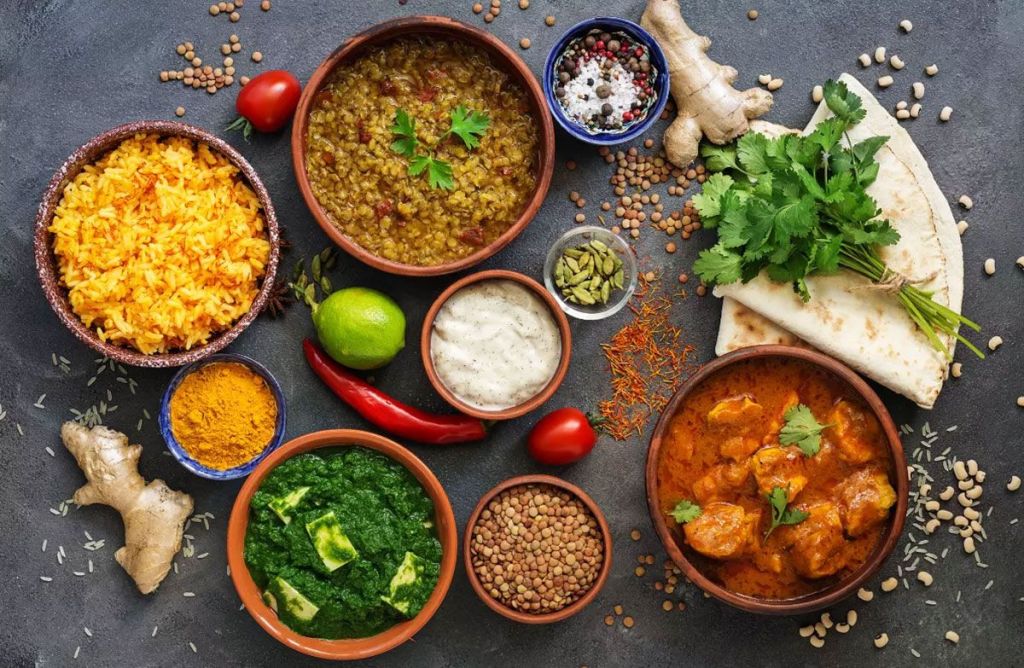
Title: The Art of Conscious Eating: Secrets for a Long and Healthy Life by Dr. Kiran Kakade & Dr. Priyanka Jawa

Image Source:https://images.app.goo.gl/EFYpGcy34n27rnT96

In our fast-paced world, we often find ourselves eating on autopilot, disconnected from the experience of nourishing our bodies. However, embracing the ancient practice of mindful eating can transform not only the way we think about food but also pave the way for a lifetime of healthy choices.

What is Mindful Eating?

Mindful eating involves focusing on the present moment, acknowledging and accepting feelings, thoughts, and bodily sensations. Dr. Lilian Cheung, a nutritionist and lecturer at Harvard T.H. Chan School of Public Health, suggests that mindful eating extends beyond the individual to consider how our food choices impact the world around us.

The Mindful Eating Journey

1. Shopping List Wisdom:
Begin your conscious eating journey with your shopping list. Carefully consider the health value of each item, filling your cart with fresh produce while avoiding the processed temptations of the center aisles.

2. Appetite Awareness:
Approach the table with an appetite, but not when ravenously hungry. Skipping meals may lead to impulsive eating. Prioritize enjoying your food over merely filling a void.

3. Portion Control:
Begin with a small portion, perhaps limiting your plate size. This sets the stage for savoring each bite rather than mindlessly consuming larger quantities.

4. Gratitude Pause:
Before diving into your meal, take a moment to appreciate the journey of your food to the table. Express gratitude for the opportunity to enjoy delicious nourishment with companions.

5. Engage Your Senses:
Bring all your senses to the meal โ€“ observe the color, texture, aroma, and sounds of your food. Identify each ingredient, especially seasonings, as you savor the experience.

6. Small Bites, Thorough Chewing:
Take small, deliberate bites and chew thoroughly. This practice allows you to fully taste the essence of each bite and discover the multitude of flavors released.

7. Eat Slowly:
Dedicate at least five minutes to mindful eating. Avoid rushing through your meal; savor the flavors and engage in mindful conversation with your tablemates.

Ayurvedic Wisdom for Longevity

In addition to mindful eating, consider integrating Ayurvedic principles into your lifestyle. Maharishi Ayurveda rasayanas, like AMRIT, strengthen the immune system and refine physiological functions. These herbal formulations, rooted in centuries-old knowledge, provide targeted support for specific imbalances.

Conclusion:
Embracing conscious eating not only nurtures your body but also fosters a deeper connection with the world around you. By incorporating mindfulness into your meals and exploring holistic approaches like Ayurveda, you set the stage for a long and healthy life.

Note: Always consult with healthcare professionals before making significant changes to your diet or lifestyle.

Title: “The Journey of Being a Role Model” by Dr. Kiran Kakade

In the hustle of daily life, have you ever paused to ask yourself, “Am I a role model?” Do you inspire those around you, be it your family, friends, team, peers, or even your boss, to strive for the best version of themselves? Let’s delve into the essence of being a true leader, beyond titles and designations.

Leadership Beyond Titles

Leadership is not confined to the titles we hold; it’s about the impact we create. The true test lies in our ability to inspire and uplift others, irrespective of our position. A leader isn’t defined by the corner office but by the positive influence they exert on those they lead.

The John Mattone Perspective

Renowned leadership expert John Mattone puts it succinctly, “Everyday when your head hits the pillow, ask yourself – Were you a Role Model today? Did you make a difference to somebody’s life today?” According to Mattone, true leadership is a daily commitment to serving others, a relentless pursuit of making a positive impact consistently.

Inspiring Through Intent, Words, and Actions

Leadership is a multifaceted endeavor. How do you inspire others? Is it through the clarity of your intent, the power of your words, the impact of your actions, or simply through your genuine presence? True leaders harness these elements to motivate and guide others towards their best selves.

Adding Value to Others

Adding value to the lives of those around you is a hallmark of genuine leadership. Mentorship, support, and constructive feedback are powerful tools to contribute to others’ growth. As a leader, your role extends beyond achieving personal success; it involves elevating the collective success of your team.

The Daily Reflection

Are you a role model? It’s not a status achieved once and forgotten. Being a role model requires a daily commitment to introspection. Ask yourself, “How did I inspire today? How did I add value to someone’s life?” True leadership is a journey of continuous improvement and service to others.

Leadership is Others

In the grand tapestry of leadership, the spotlight isn’t on the leader but on the positive change they instigate in others. It’s not about personal glory; it’s about guiding others to shine. So, are you a role model? The answer lies in your actions, your impact, and your unwavering commitment to others.

In the end, the essence of leadership is captured not in self-reflection but in how you inspire and add value to the lives of those around you.

Title: Transforming Indian Higher Education: A New Era of Accreditation by Dr. Kiran Kakade

Introduction

The Indian higher education landscape is undergoing a significant transformation aligned with the National Education Policy (NEP) 2020. With a target of achieving a 50% Gross Enrollment Ratio (GER) in higher education by 2037, the emphasis is on enhancing education quality. This evolution is dependent on various factors, including teaching-learning processes, research and innovation, motivated faculty, employability skills, equity, societal integration, academic ambiance, and sustainability commitments.

A pivotal aspect of this transformation is the reform in the accreditation and ranking process. In a major development, the Ministry of Education established a committee led by Dr. K. Radhakrishnan to propose transformative reforms for strengthening the assessment and accreditation of higher education institutions in India.

The committee’s preliminary report, made available for public consultation, culminated in a final report presented to the Minister of Education on January 16, 2024. The proposed reforms aim to streamline the approval, assessment, accreditation, and ranking processes, aligning them with the vision of NEP 2020.

Key recommendations include the introduction of Binary Accreditation, a simplified “accredited or not accredited” system to encourage widespread participation in the accreditation process. Additionally, a Maturity-Based Graded Accreditation system (Level 1 to 5) aims to motivate institutions to continuously improve, evolving into centers of national and global excellence.

Crucially, the accreditation metrics focus on Processes, Outcomes, and Impact across various attributes, moving away from input-centric evaluations. Recognizing the diversity of higher education institutions, the new process categorizes them based on their orientation and heritage, ensuring a tailored approach rather than a one-size-fits-all model.

Special attention is directed towards rural and remote institutions through mentoring and handholding initiatives. The proposal includes the creation of a ‘One Nation One Data Platform’ for integrity and transparency in handling institutional data. This platform will capture a comprehensive dataset from institutions, facilitating approval, accreditation, and ranking purposes.

To enhance the validity and reliability of data, a ‘Stakeholder Validation’ mechanism is introduced, integrating stakeholders into the accreditation and ranking process. The system adopts a trust and data-driven approach, minimizing on-site visits for verification while imposing heavy penalties for incorrect submissions.

The National Assessment and Accreditation Council (NAAC) Executive Committee has endorsed the reforms, outlining a phased implementation. Binary accreditation will be implemented in the next four months, with maturity-based graded levels scheduled for December 2024. Institutions have the flexibility to choose between the existing process and the new methodology during this transition.

By comprehensively implementing these reforms before the end of 2024, the Indian higher education system aims to undergo a remarkable transformation, elevating the quality and credibility of institutions and contributing to India’s socio-economic leadership in line with the visionary Amrit Kaal mission.

Title: Unveiling the Red Car Theory: Spotting Opportunities in Plain Sight by Dr. Kiran Kakade

Source:https://images.app.goo.gl/T6KXvCFdouw6Z5Wz6

Have you ever found yourself oblivious to the sheer number of red cars on the road until someone challenges you to count them? It’s a peculiar phenomenon, and it unveils the intriguing concept known as the Red Car Theory. This theory isn’t about automobiles; it’s about awakening our awareness to opportunities that often slip past us unnoticed in our daily lives.

The Unseen Opportunities

In the hustle and bustle of our routines, we often navigate through life on autopilot, missing out on countless opportunities that surround us. The Red Car Theory encourages us to break free from this tunnel vision, urging us to actively seek out possibilities that might be hiding in plain sight.

Shifting Perspective

Much like the red cars that become more conspicuous once you start counting them, the Red Car Theory challenges us to shift our perspective. By consciously looking for opportunities, we begin to notice them everywhere, transforming the mundane into the extraordinary.

Mindful Awareness

The heart of the Red Car Theory lies in cultivating mindful awareness. It’s about training ourselves to be present in the moment, attuned to the details that might escape casual observation. This heightened awareness not only opens doors to new possibilities but also enriches our overall experience of life.

Applying the Red Car Theory

So, how can we apply the Red Car Theory to our daily lives? Start by setting small goals โ€“ challenge yourself to notice something new each day, be it a potential connection, a business idea, or a personal growth opportunity. Gradually, this practice becomes a habit, expanding your field of vision and unlocking a world of possibilities.

Overcoming Inertia

The Red Car Theory also addresses the inertia that often holds us back. Just as we might dismiss red cars as commonplace, we may overlook opportunities due to preconceived notions or fear of change. Embracing the Red Car Theory empowers us to overcome this inertia, propelling us towards personal and professional growth.

Final Thoughts

In a world that constantly bombards us with information, the Red Car Theory serves as a reminder to pause, observe, and actively engage with our surroundings. By embracing this concept, we can transform the ordinary into the extraordinary, unlocking a wealth of possibilities that enrich our journey through life. So, next time you’re on the road, take a moment to appreciate the red cars โ€“ and the opportunities โ€“ that surround you.

Title: Unraveling the Mahabharata Within: A Journey into the Depths of Human Consciousness by Dr Kiran Kakade

Source: https://images.app.goo.gl/MW6gLWYJKCAJMgLy8

In the epic tale of Mahabharata, the intricate web of relationships and battles unfolds a profound metaphor for the human psyche. As we delve into the narrative, we find that Mahabharata is not just a story of a kingdom at war; it is a reflection of the internal struggle within each one of us.

Dhritarashtra: The Blind King, The Blind Brain

At the helm of this internal kingdom sits Dhritarashtra, the blind king, representing the blind brain within us. Dhritarashtra never reacts to the information he receives; he simply lets it flow, much like how our brains absorb vast amounts of information, processing only a fraction of it based on personal interests.

Kauravas: The 100 Emotions

In this inner kingdom, the 100 Kauravas symbolize the myriad emotions and feelings that control our blind brains. They influence our decisions, often steering us away from rationality. Just as Dhritarashtra comes under the influence of these emotions, our blind brains are subject to the sway of our myriad feelings.

Pandavas: The 5 Senses

According to the teachings of the Geeta, the 5 Pandavas are akin to our 5 senses. To conquer the 100 negative emotions (Kauravas), one needs the guidance of these senses. Draupadi, the common purpose binding the Pandavas, signifies the need for a unified purpose to bind our senses and navigate through the chaos of emotions.

Krishna: The Consciousness that Guides

In the grand tapestry of Mahabharata, Krishna emerges as the symbol of consciousness. Krishna guides the senses, the brain, and the purpose, illustrating the role of consciousness in navigating the intricate paths of life. It is the guiding force that harmonizes the internal elements of our being.

Karna: The Ego’s Dominance

As we reflect on the characters of Mahabharata, Karna represents the ego within us. When allowed to dominate, the ego becomes destructive, potentially leading to our downfall. Balancing and taming the ego is crucial for maintaining harmony within.

In the labyrinth of Mahabharata lies a timeless lesson โ€“ the battle within. Understanding the dynamics between Dhritarashtra, the Kauravas, the Pandavas, Krishna, and Karna unveils a roadmap for self-awareness and introspection. It prompts us to ask: How can we harmonize our senses, purpose, and consciousness to triumph over the chaos within?

Source: Harish Trivedi’s LinkedIn Post

Patent Registration Process in India: From Application to Publication by Dr. Kiran Kakade

Introduction

Patents, as a cornerstone of intellectual property rights, play a pivotal role in protecting innovation. In India, the process of securing patent rights is governed by the Indian Patent Act of 1970. This blog aims to unravel the intricacies of the patent registration procedure in India, delving into each step and shedding light on the timeframes involved.

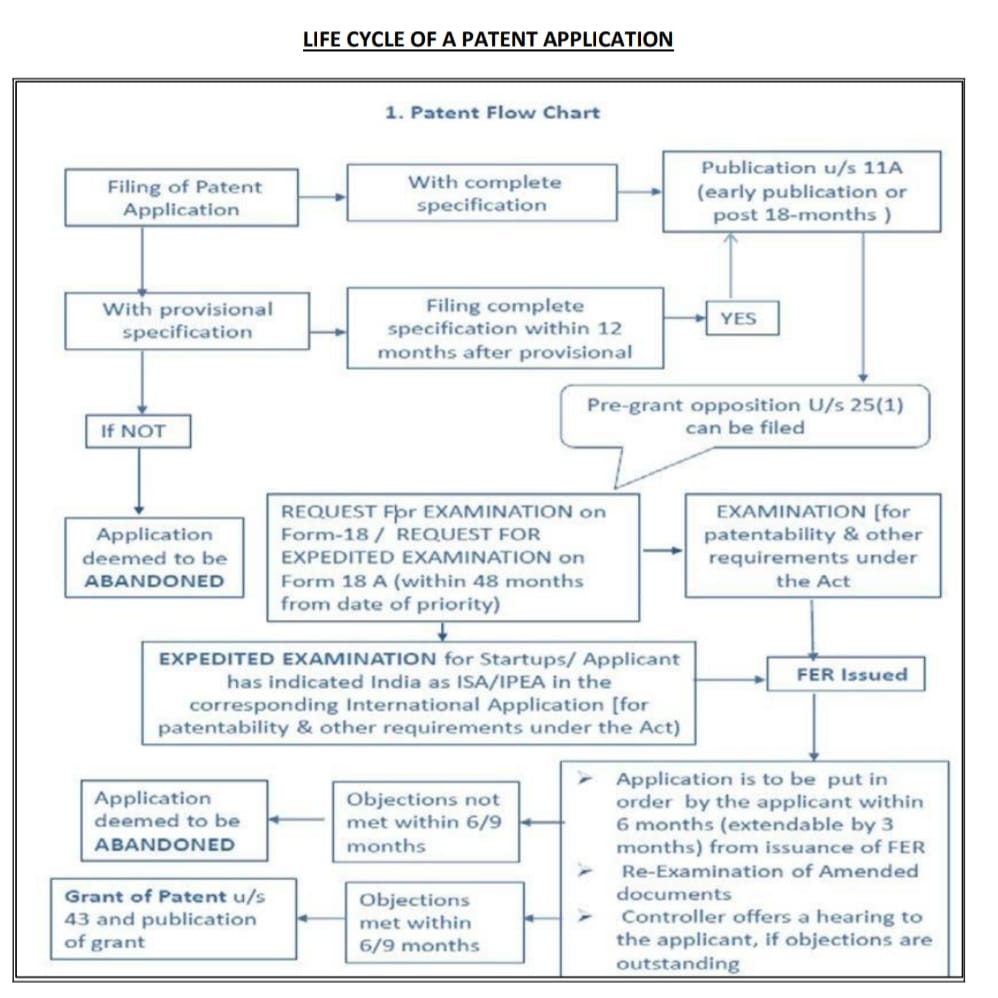
Source : https://ipindia.gov.in/

Step 1: Patent Search

The journey commences with a crucial step โ€“ the Patent Search. This initial exploration, conducted globally, serves to determine the novelty of the invention. It sets the foundation for the entire patent registration process.

Step 2: Drafting Patent Specification

Following exhaustive searches, the specification of the invention takes shape in a techno-legal language. Whether with or without inventor’s claims, this document encapsulates the essence of the invention. A provisional specification lacks claims, while a complete specification provides a detailed disclosure.

Step 3: Patent Application Filing

The filing process kicks off after drafting the Patent Specification. Patent Applications can be provisional or complete, serving distinct purposes. Six different types of Patent Application forms cater to specific needs, ranging from an ordinary application for Indian protection to PCT International applications for global coverage.

Step 4: Patent Publication for Public Opposition

After completing the patent application process, the patent undergoes publication. This occurs 18 months from the filing date or priority date, opening the door for public scrutiny. This phase allows the public to raise valid objections to the patent.

Step 5: Requesting Patent Examination

Examination is initiated upon filing a request, mandatory within 48 months of the filing date or priority date. The patent examiner scrutinizes the application, issuing an examination report with objections. A timely response, within 12 months, marks the patent prosecution phase.

Step 6: Grant of a Patent

Successful navigation through objections leads to the final phase โ€“ the grant of Patent Registration. However, if the examiner remains unsatisfied, rejection prompts a revisit of the entire patent procedure in India.

Conclusion

Understanding the intricacies of the patent registration journey empowers inventors and innovators. It provides valuable insights into the timeframes associated with each phase, fostering a strategic approach to securing intellectual property rights in the dynamic landscape of innovation.

Title: Nurturing Emotional Well-being: A Guide to Better Emotion Management by Dr. Kiran Kakade


In the fast-paced landscape of today’s world, the ability to navigate and understand our emotions is crucial for personal growth and well-being. Here are key strategies to help you manage your emotions more effectively.

1. Diverse Mediums of Expression:

Expressing your emotions through various mediums can be a powerful tool for self-discovery and growth. Whether it’s journaling, talking to a trusted friend or therapist, or engaging in creative activities like painting or dancing, finding healthy outlets allows emotions to flow constructively. This not only aids in processing feelings but also contributes to a more holistic personal development.

2. Open Communication:

Bottling up emotions often leads to stress and strain on mental health. Open communication acts as a safety valve, preventing emotional pressure from reaching unhealthy levels. Whether you’re sharing your thoughts with a friend, a family member, or a mental health professional, the act of verbalizing emotions can provide relief and contribute to a healthier emotional release.

3. Developing Emotional Intelligence:

In a world that values not only intelligence quotient (IQ) but also emotional intelligence quotient (EQ), understanding and managing your emotions is key. Enhance your emotional intelligence by delving into self-awareness. Recognize your own emotions, understand their origins, and learn how to respond effectively.

4. Empathy for Others:

Emotional intelligence extends beyond self-awareness. Cultivate empathy to understand and resonate with the emotions of others. This not only strengthens your interpersonal relationships but also contributes to a more harmonious and compassionate community. Practicing empathy fosters a deeper connection with those around you, creating a supportive environment for emotional well-being.

5. Mindfulness Practices:

Incorporate mindfulness into your daily routine to stay present and attuned to your emotions. Mindful practices, such as meditation or deep-breathing exercises, can provide a calm space for introspection and emotional regulation. Regular mindfulness can positively impact your overall emotional resilience.

Conclusion:

Managing emotions is a lifelong journey that requires continuous self-reflection and growth. By expressing yourself through different mediums, fostering open communication, and developing emotional intelligence, you pave the way for a healthier emotional landscape. Remember, understanding and managing your emotions not only contributes to personal well-being but also creates a positive ripple effect in your relationships and interactions with the world.