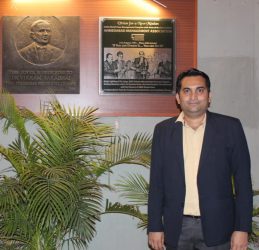
Title: Private Companies: A Driving Force in India’s Future Space Missions by Dr. Kiran Kakade

Source:https://www.space.com

Introduction:
India’s journey into space exploration has reached new heights, with private companies emerging as significant partners. V.K. Saraswat, a member of NITI Aayog and a distinguished defence scientist, believes that private companies will play a major role in India’s future space missions, including those destined for Mars and Venus. In an interview, Saraswat emphasized India’s technical capabilities, global aspirations, and the need for scaling up to capture a larger share of the global space economy.

Private Sector’s Crucial Role:
Saraswat envisions a future where private companies will actively participate in India’s space endeavors. He expects that future programs such as the Gaganyaan (manned space mission), missions to Mars and Venus, will see substantial contributions from the private sector. This collaboration could involve the supply of sub-systems, components, devices, and even joint partnerships for significant launches. Saraswat’s perspective underscores the government’s initiative to open up the space sector to private enterprises, resulting in the emergence of multiple companies engaged in satellite technology, launch vehicles, and subsystems.

India’s Self-Reliance and Technical Prowess:
Saraswat strongly asserts that India’s technological prowess in space is on par with the best in the world. He highlights India’s recent achievement of landing Chandrayaan-3 on the moon’s south pole as a testament to the country’s strength and self-reliance in space exploration. Saraswat believes that the success of missions like Gaganyaan will propel India even further, opening up possibilities for space stations and deep space probes.

Private Sector’s Innovations:
Private companies are already making notable contributions to the Indian space ecosystem. Startups are playing a pivotal role by offering innovative solutions, ideas, and technologies that augment the growth of the space sector. Collaborating with the Indian Space Research Organisation (ISRO), startups are participating in various projects, bringing technological expertise and entrepreneurial spirit to the table. ISRO’s support to startups includes technology transfer for specialized components and the provision of launch sites for trial runs of private players’ launch vehicles.

Challenges and the Road Ahead:
While India’s achievements are commendable, Saraswat acknowledges the need for scaling up and building greater capacity. He believes that India’s current launch vehicle capabilities are on par with the world’s best. However, scaling up payload capacity remains a priority. Additionally, challenges related to value addition in domestic laptop and desktop manufacturing need to be addressed to fully tap into India’s vast market potential.

Conclusion:
India’s ambition in the space sector is poised for remarkable growth, driven by collaborations with private companies and a government keen on fostering innovation. The participation of private players in various aspects of space technology, from satellite development to launch vehicles, signifies a dynamic shift in India’s space exploration narrative. With support from both public and private sectors, India is well on its way to solidifying its position as a significant player in the global space economy and unlocking new frontiers of exploration.

Author Details:                        Dr. Kiran S. Kakade         (Ph.D., MBA(HR), LL.M., MCA)  Associate Professor (HR),LLIM ,   Mumbai University,  Website:-  http://www.drkirankakade.com

Title: Reviving Ancient Wisdom: Millennial Insights into India’s Knowledge System by Dr Kiran Kakade

Source : http://ancientindianwisdom.com

Introduction:


The Indian Knowledge System (IKS) stands as a repository of profound wisdom that spans millennia, and Prime Minister Narendra Modi’s recent call to rekindle its flame resonates deeply with the millennial generation. This blog delves into the perspectives of millennials on the ancient IKS, exploring its relevance in the modern world and its potential to reshape their understanding of history, science, and innovation.

Embracing Ancient Achievements:


PM Modi’s assertion that India’s ancestors delved into astronomical observations and space exploration thousands of years ago presents an awe-inspiring narrative for millennials. The PM’s challenge to reexamine these age-old scriptures through a scientific lens stirs their curiosity and encourages them to uncover the remarkable insights hidden within ancient texts.

Rediscovering Lost Wisdom:


The Prime Minister’s emphasis on great Indian sages like Aryabhatt, Brahmagupta, Varāhamihira, and Bhaskaracharya, who predated Western scientists in their astronomical discoveries, ignites a sense of pride and curiosity among millennials. The prospect of unveiling forgotten knowledge, validated through modern scientific methods, intrigues a generation that thrives on exploring uncharted territories.

Reimagining Earth’s Shape:


Aryabhatt’s assertion of Earth’s spherical shape and its rotation on an axis resonates with millennials, who have grown up with space exploration and satellite imagery. The understanding that these insights were documented centuries ago provides them with a unique connection to their cultural heritage while affirming their place in a global scientific community.

Sanskrit’s Resurgence:


The significance of Sanskrit as a carrier of multidisciplinary knowledge resonates with millennials, who understand the value of diverse skill sets in the modern world. Sanskrit’s richness in poetry, logic, philosophy, and science provides a nuanced view of IKS as more than a historical artifact—it’s a dynamic tool that can still influence various fields today.

Incorporating Ancient Insights:


The call to incorporate IKS into higher education curricula strikes a chord with millennials, who seek a holistic and well-rounded education. The proposed credit courses on Indian Systems of Medicine, Ayurveda, Siddha, and Vedic astronomy offer them a chance to explore the practical applications of ancient knowledge in contemporary contexts.

Unearthing a Dual Responsibility:


PM Modi’s dual responsibility for millennials—to preserve the heritage of ancient wisdom and to subject it to modern scientific scrutiny—reverberates with a generation that values both tradition and innovation. They recognize the potential to contribute to global scientific advancements while safeguarding their cultural identity.

A Gateway to Innovation:


The concept of using Sanskrit in computing and natural language processing piques the interest of tech-savvy millennials. The idea that an ancient language can find resonance in cutting-edge technologies aligns with their fascination for merging the past and the future seamlessly.

Conclusion:


Millennials are uniquely poised to bridge the gap between centuries-old wisdom and the technological advancements of today. PM Modi’s call to explore and validate IKS not only enriches their understanding of history but also offers them a chance to reshape the narrative of cultural identity, scientific inquiry, and innovation. By embracing this challenge, millennials can contribute to a future where the wisdom of the past propels humanity forward.

                                                                                                                                  Author Details:                                   Dr. Kiran S. Kakade                    (Ph.D., MBA(HR), LL.M., MCA)  Associate Professor (HR),LLIM , Mumbai University http://www.drkirankakade.com