

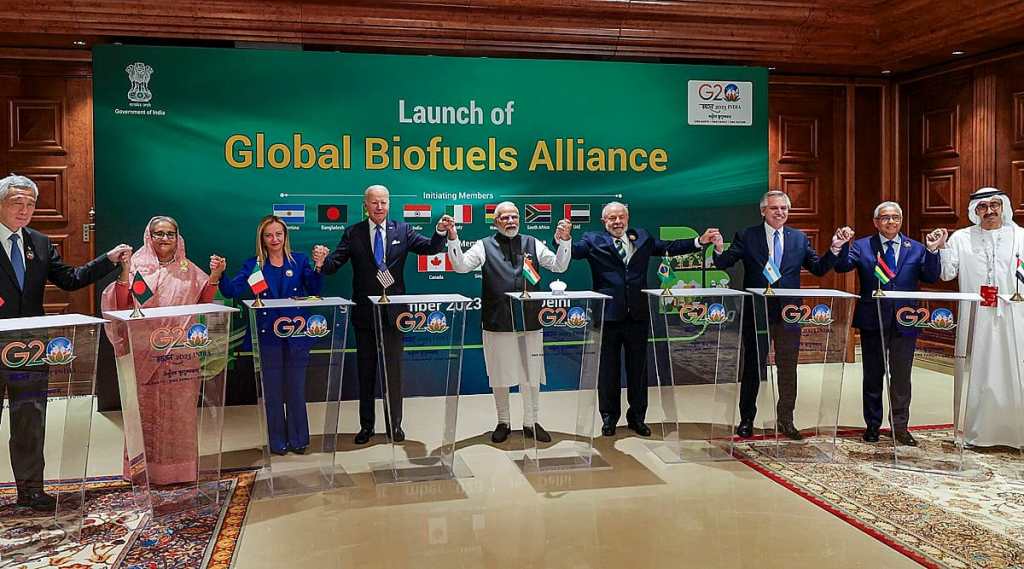
Source:- https://indianexpress.com
Introduction:
On September 9, 2023, Prime Minister Narendra Modi of India made a significant announcement that will have a lasting impact on the global energy landscape. He introduced the Global Biofuels Alliance, a collaborative effort aimed at advancing sustainability and clean energy through biofuels. This alliance comprises 19 countries and 12 international organizations, with India, Brazil, and the United States as its founding members. In this blog post, we will delve into the details of this alliance and explore its potential to reshape the future of energy.
Founding Members and Participants:
The Global Biofuels Alliance brings together a diverse group of nations, including G20 members and non-member countries. In addition to the founding members, Argentina, Canada, Italy, and South Africa, several G20 invitee countries such as Bangladesh, Singapore, Mauritius, and the UAE have expressed their support. Notably, non-G20 countries like Iceland, Kenya, Guyana, Paraguay, Seychelles, Sri Lanka, Uganda, and Finland are also eager to participate. Moreover, various international and multilateral organizations, including the World Bank, Asian Development Bank, World Economic Forum, and more, have shown interest in the alliance.
Significance of the Alliance:
The Global Biofuels Alliance aims to address several critical global challenges:
- Reducing Carbon Emissions: Biofuels are considered a cleaner alternative to traditional fossil fuels, as they can significantly reduce carbon emissions when used for transportation and energy production.
- Enhancing Energy Security: By promoting the production of biofuels, member nations can reduce their dependence on oil imports and enhance energy security.
- Technology Transfer: The alliance will facilitate the transfer of biofuel production technologies, benefiting both developed and developing nations.
- Trade Boost: It will create opportunities for global trade in biofuels, fostering economic growth and cooperation among member countries.
Exclusion of Some Nations:
Notably, China, Saudi Arabia, and Russia have chosen not to participate in the alliance. This decision may be connected to their membership in the Organization of the Petroleum Exporting Countries (OPEC) and their focus on traditional oil production.
Global Biofuels Alliance’s Vision:
The G20 Leaders’ Declaration emphasizes the importance of sustainable biofuels in zero and low-emission development strategies. The alliance’s vision includes:
- Cooperation: Member countries intend to cooperate voluntarily to intensify the use of sustainable biofuels.
- Market Development: By strengthening collaboration between producers, consumers, and interested nations, the alliance seeks to bolster biofuels markets.
- Standards Development: It will encourage the development of globally recognized standards in the biofuels sector.
- Industry Participation: Industry participation is crucial, and the alliance aims to engage stakeholders actively.
A Global Imperative:
The International Energy Agency (IEA) estimates that global biofuel production must triple by 2030 to align with a net-zero emissions goal by 2050. In India, the government is committed to achieving carbon neutrality by 2070 and has set ambitious targets for ethanol blending in petrol.
Conclusion:
The launch of the Global Biofuels Alliance is a milestone in the global transition towards sustainable and clean energy. It demonstrates the commitment of nations to combat climate change, enhance energy security, and foster technological cooperation. As biofuels play an increasingly significant role in the world’s energy mix, this alliance has the potential to drive innovation, reduce emissions, and reshape the energy landscape for generations to come.

 Dr. Kiran Kakade (Ph.D.,LL.M.,MCA,MBA(HR))